
Smitty's Boy
On Honoring the Past Without Romanticizing It


My Grandpa, Henry Lee Smith, or as everyone called him –Smitty–birthday just passed. February 4th. I woke up today, February 10th, upset with myself that I did not take the time to acknowledge him. Pray for him. Or just even make space to honor him. I even passed over my Mother’s text reminding me it was his birthday.
So, I’ve decided to write something about Smitty that has honestly been locked away in my mind for years, because every time I really think about him, I break down and cry.
And not one of those single drop tears slowly sliding down my cheek. I’m talking about curling into a cradle position, tears crashing like a thunderstorm inside my head, mumbling things like:
“I wish I could have helped him”
“I wish I loved him until the end”.
This is about my grandfather — but it is, of course, political as well. Because what you will see is that my grandfather is simply a microcosm of everything this world produces.
A Black man who grew up in poverty.
Who experienced immense violence.
Who tried to pick himself up and build something.
And somehow did.
Only to have it taken away.
Some of that because of the socialized behaviors birthed into him by capitalism, patriarchy, and white supremacy — but in my perspective, far more as the result of the conditions he was brought into, alongside his family.
For this piece, I am going to tell you about my Grandpa Smitty — first as I experienced him over the years. And then how I came to understand him as I matured.
Smitty was born in 1943 and died in 2015. I was born in 1993. I knew nothing about his life beforehand, but as soon as I came into this world, all I could tell you is that I loved this man.
He was 6’1”, dark-skinned, and stout. He had a voice that felt like thunder — but at least with me, he was a gentle giant. With my pops being incarcerated, Smitty was my father for most of my life.
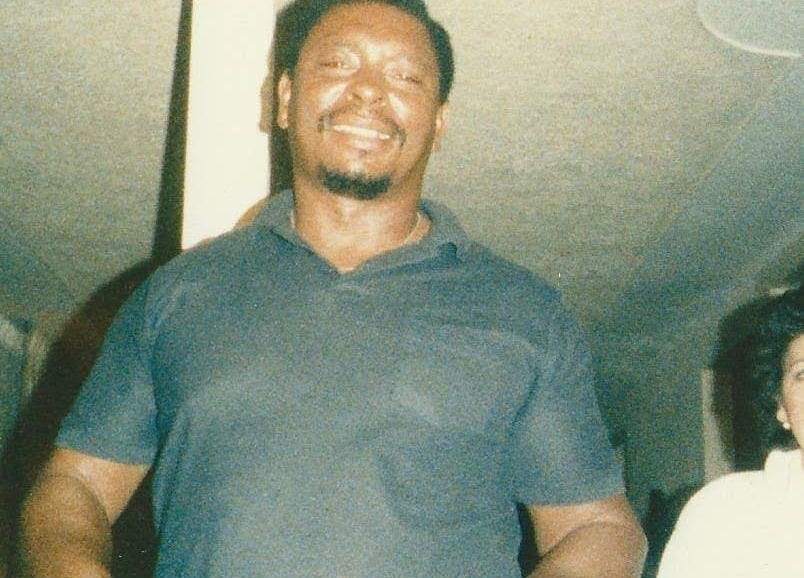
My earliest memory of my grandpa, when I was about four, is me lying in bed with him. The lights were off, and he turned a flashlight onto the ceiling and used his fingers to make all types of animals and funny figures on the ceiling.
I remember sitting there curious and amazed, thinking my grandpa was some kind of wizard or something.
Grandpa Smitty was also a businessman — and as far as I understand, a pretty damn good one. He had multiple tire shops across San Diego — Smitty’s Tire Shops.
I don’t know if he actually took me to work frequently, but it felt like he did. I remember watching him interact with people. The way he demanded respect. The way people seemed to admire him.
Him picking up tires and moving through spaces with his head held high, like he owned the place… well, because he did.
People would come talk to me and ask if I was “Smitty’s boy,” and tell me how all Smitty did was talk about me and his family.
After a long day of work, my grandpa would take me to a toy store and let me pick something I wanted. It was always a Power Ranger.
And then we’d head home in one of his many fancy cars — my grandpa used to compete in car shows — windows rolled down, and I’d just be sitting there happy, without a care in the world.
Oh, how I miss those days.
Smitty was my superhero. He had all the attributes.
Strong.
Handsome.
Charismatic.
And he looked like me.
And he protected me.
When I was around seven, there was a moment that really solidified him as my hero.
My grandpa was a businessman, like I shared earlier, and he understood the importance of owning land. He was also a bit of a mountain man and seemed to really enjoy being in nature.
One day, me, my mom, and my aunties were going to visit one of his properties. It felt like this little forested area, almost like stepping into another world.
To get there, we had to cross a small river bed. There was a rocky pathway across that should have been easy to walk.
My whole family crossed first. I was last.
Halfway across, I noticed all these little crabs starting to circle around me. In my seven-year-old brain, they weren’t just crabs. They were piranhas.
I froze.
I started crying.
Convinced they were about to eat me alive.
My family was laughing from the other side.
And then, out of nowhere, my grandpa came rushing in, picked me up, and carried me across. I don’t remember him laughing at me. I only remember him making sure I was okay.
Smitty was my hero to my younger self.
But soon, reality would kick in.
There’s that line from The Dark Knight — you either die a hero, or live long enough to become the villain. But the truth is, if you live long enough, you become complicated in somebody’s story.
My grandpa never became the villain in mine. But slowly — painfully — he stopped being my superhero.
I don’t know when things started changing. I didn’t clock the nice house disappearing at first. Or the fancy cars turning into a motor home. Or the business fading.
Or maybe I noticed — and just refused to name it. Because as long as I had my grandpa, I thought that was enough.
But those things did disappear. And with them, the version of my grandpa who moved through the world like nothing could touch him.
His head never really dropped. But his words started sounding like someone holding onto hope with both hands. Like someone trying to figure out how to get back to who they used to be.
Back to when he could provide.
Back to when he was still with my grandmother.
Back to when he still had his family under one roof.
Or when people looked at him with admiration, rather than pity.
Sometimes, when he would come over to the family house—where everyone lived but him—and he would ask if my grandmother was home.
It felt like he wanted to speak to her, but was also ashamed. Of what, I didn’t really know at the time. But it was like he was trying to step back into a life that was already gone.
During my teenage summers, my mom would drop me off at his apartment that was paid by my auntie.
We would just sit there. Watching Jeopardy. Watching one of those cheesy courtroom shows, like Judge Judy. I don’t really know if my Grandpa even changed the channel. Just consuming whatever came on next. Eating canned food. Microwave meals.
The apartment always felt a little lifeless. It was messy. The air was stale — to the point where I’d have to step out onto the patio just to breathe a little.
We would talk here and there, but the conversations were often him telling me about the tire shop. The old house on 13th Street. His old Cherry Red Snub Nose truck. And how, when he won the lotto, he was going to buy me an old classic car that we could work on together.
But we just ran those conversations on repeat and sat in that apartment. In many ways, the apartment felt like a reflection of the stage my grandfather was in.
It felt like decay was in progress. Just kinda there. Without purpose. Slowly becoming a shell of the person I used to know.
Sometimes we would walk across the street to Heritage Park. I would play basketball. He would sit and watch for a while. And then we would walk to the pond, and he would feed the ducks for hours.
He loved feeding those ducks. Like it slowed the world down for him. Like it gave him something to do. Somewhere to be.
And even then, people would still recognize him and of course tell me:
“You Smitty’s boy?”
“All he does is talk about you.”
After that apartment, things got messier.
He started living full time in his motor home. Driving across San Diego County. Parking wherever he could. Disappearing for weeks. Sometimes months.
It became normal for family conversations to start with:
“Has anyone talked to Smitty?”
“Does anyone know where he is?”
Sometimes we would go looking for him. Not knowing if we were going to find him alive. Worried we might find him dead in that motor home.
Sometimes we’d find him high in the motor home, with some random person. Other times, he’d just randomly show up like nothing happened — but often, it was him coming around to ask for money.
Around this time, I needed him the most.
I was 13 or 14. Trying to figure out who I was. Trying to make sense of being a young Black boy turning into a young Black man.
But instead of saying that — saying that I needed him — I’d invite him to my basketball games. Or ask him to come to church with me.
He would always say, “I’ll try. I’ll be there.”
From second grade through college football, I played hundreds of games. My grandpa never made it to one. I don’t know if that’s where resentment started. But that’s where something inside me cracked.
People kept telling me how much he talked about me. But I started feeling like he was a man who talked a lot, but never once showed up. I could feel my mom and my aunties getting tired. The calls asking for money. The stress. The feeling that he was becoming a burden.
And slowly, those feelings started living in me too.
Then one day, when I was in middle school, he asked me for money. I didn’t have much. I sold Starburst and Skittles at school. Did chores. Saved what I could for movies or games.
I gave him $20 because he needed it. And also because there was a small part of me that hoped the money might buy me a little time with him.
But it didn’t.
He just disappeared again.
That moment sat heavy in me. Not because of the money. Because of what I thought love was supposed to do.
You start to internalize some cruel thoughts:
“Why doesn’t he want to spend time with me?”
“Is there something about me that is unlovable?”
“How could he just leave me, when he knows I don’t have my father?”
There was chaos in those years. He crashed into a trolley and survived. He had multiple hospital visits — all different types of issues. Heart failure. A stroke. And more. It felt like I saw him more in the hospital than outside of it. But he always pushed through.
And part of me was still amazed by his ability to survive. I stopped caring about inheritance or time with him. I just wanted him to pass down that survival instinct. That ability to keep going, no matter what. I thought if I had that, maybe I’d be okay.
When I was a freshman in high school, my mom let him move in with us. Part of me thought: here we go. Another burden. Part of me thought: maybe this is his redemption arc.
Maybe now we’d talk about being Black men. About business. About life. About women. About his family history and who I come from.
Maybe we’d finally build that car together, like he always said.
Maybe now he’d come to my games — because now all he had to do was walk across the street. Instead, life was… quiet. And heavy in a different way. He watched TV all day. I’d come home and see him sleeping on the couch. Sometimes I would get upset, hoping he didn’t bring that same decay from his last apartment into our home.
Sometimes he still asked for money. Me and my friend Trevon would prank him by turning the TV off from upstairs with another remote. Watching him get confused and get up to turn it back on.
My mom would cook big pots of food to last the week. Red beans and rice. Ham hocks. And by the time we got home, half would be gone, because he had picked at it all day. Eventually, she had to start hiding leftovers so we’d have food later in the week. There were funny moments. Stories I can laugh at now. But it wasn’t the rebuilding I hoped for.
After a year, we moved out of that home, and he drifted away again. This time to the mountains, so he could “be free,” in his words. I did the same, in my own way. And life just sort of moved along for everyone. I left to Nebraska for college. My grandma dated men who showed up to my games. And I started telling myself that was enough. Around this time, I stopped being Eric Smith and became Eric Morrison-Smith.
I used to tell the story like it was about honoring two family lines. But the truth is — it was also anger. It was me distancing myself. It was me taking back control of who got to claim me. It was, in some ways, a “fuck you” to both of the men in my life. Neither of you get to claim me as yours alone. I get to make my own path. But it was a weird way of holding both sides of my family close, while also pushing them away.
By then, I had mostly given up hope when it came to Smitty.
When I came back from school, sometimes my mom would say, “Let’s go find Grandpa,” and I’d go for her. Not for him. Not for myself.
I remember talking badly about him once to my little cousin — who loved him the way I used to.
He told me to stop being mean. Said Grandpa just needed help. That we just needed to love him because he was family. And I told this little boy — the same age I was when I saw Grandpa as a superhero — that he just didn’t understand yet.
I hate that memory now.
The last clear memory I have is visiting my grandpa in the hospital. Just assuming that he would somehow make another miraculous recovery. But this time, he was even thinner than I had ever seen him. In a wheelchair. And his mortality really began to set in for me.
This was really it. Time to say goodbye. Then he was just… gone.
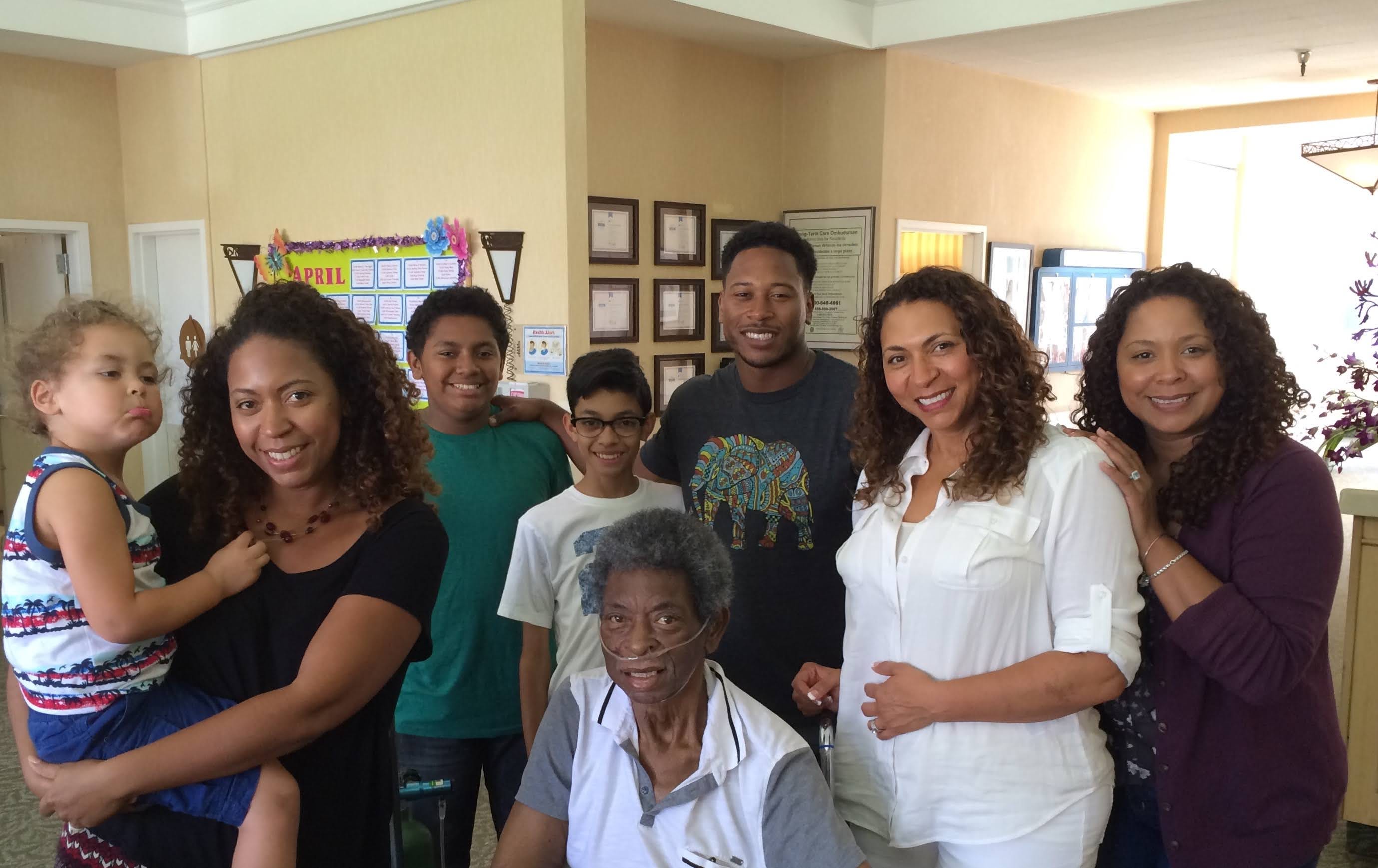
I don’t remember if I cried. I probably did. But I moved on fast. No real funeral. Maybe a small gathering. But I just left for college again and just kept moving. If I’m honest, I locked a lot of this away. Because loving him hurt. And losing him hurt. And not knowing how to help him hurt the most.
The Real Tragedy
If I’m being honest, the real tragedy of this story isn’t my grandfather’s death.
It’s everything I learned about his life after it.
This is the part where my grandpa moved from superhero to human. Not in a way where the pain, resentment, and disappointment disappeared. But in a way that complicated all of it. In a way that forced me to contextualize him.
The flawed man.
Who I still love deeply.
My grandpa was born in 1943. And as we can all imagine, a Black man with his level of pride, coming up during that time, was bound to experience racist violence. And he did.
I don’t remember much about my great-grandfather, Henry Curtis Smith. But I do remember one time my grandpa took me fishing with him and my great-grandpa.
They argued the entire time. Cursing at each other. Tension thick in the air.
I remember being terrified of my great-grandfather. At one point, my hook got caught in an awkward way, and my great-grandpa started yelling at me.
My grandpa got in his face and said, “Don’t you ever talk to my boy that way.”
Thinking about it now, maybe this is the protection he wished he could have provided to others in his past.
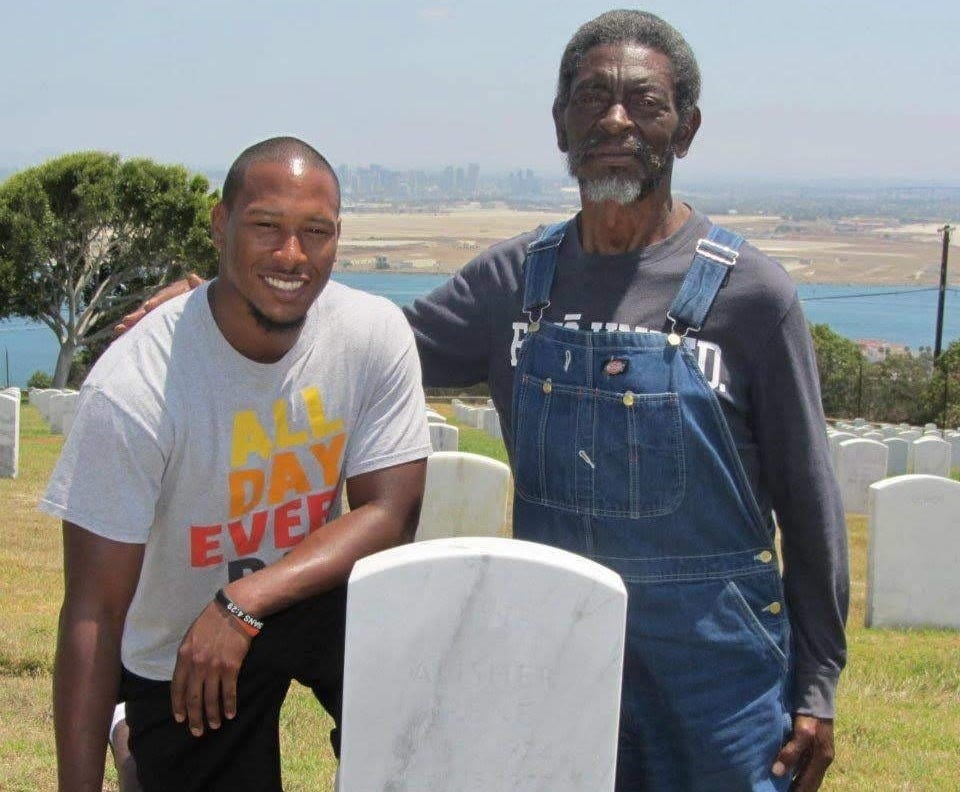
Later in life, I also learned my grandpa was extremely close to his mother, Alisher Smith. And when he was around 20 years old, she was violently killed right outside their home. Another person he loved, who he could not protect.
This was probably told to me when I was younger. But I don’t think I was old enough to understand the ways that communal violence traumatizes and stays with you for the rest of your life.
What I do remember is one of the times when I came home from college, my mom and I found him and took him out to eat. He didn’t ask for money this time. Instead, he asked my mom to take him to see his mom.
That confused me. Because he never really talked about his parents. My mom — being who she is — said yes. We drove up a winding hill in Point Loma. We walked through rows of tombstones and eventually found his mother’s grave. Right next to his father’s. He ignored his father. And just stood there where his mother laid.
He didn’t say much.
Just talked about how much he missed her. And I think that was the first time in years I saw real emotion in him. Real pain. Real regret.
And later, when my mom told me again how his mother died, I remember thinking: If something like that happened to my mom…I might give up on life. But Smitty didn’t.
After he died, I learned more.
I learned he grew up in poverty.
I learned he didn’t graduate high school. And built his business skills through odd jobs. Not selling candy at school like I did, but working hard manual labor jobs as a teenager. Fixing roofs. Selling whatever he could. My Grandma read this essay, and just told me that one time, he got his hands on all these old antique pots and sold them to hippies so he could pay for them to go on a trip to Oregon.
After his death, I learned he spent time in youth prison and in jail. Matter of fact, I learned that when my grandma was pregnant with their first child, he was inside Youth Authority — which were basically state-run youth prisons, known for being extremely violent and abusive. Our organization, alongside other partners, just closed those facilities down in 2023 for good in California.
I learned stories about the superhero moments his daughters experienced — where he defended them against racist white men. I learned that my mom never once saw him cry until I was born. And that he wanted to name me Henry too.
My mom said no — but accepted his second choice, which was Eric.
And I also learned about some of his rougher edges, and the ways he wasn’t the same father to me as he was to my mother and her sisters.
I learned that the house and cars didn’t just disappear randomly.
I learned he had illegally stored tires in the mountains. Faced lawsuits. Even got my grandma arrested in the process. He faced white male prosecutors who were determined to take everything from this Black man — his businesses, his land, his home, and his dignity.
And I name that not to make excuses.
It was illegal. It could have caused harm. But I can’t ignore how this country treats poor and working-class Black men versus how it treats the ruling elite.
Men who destroy ecosystems.
Men who exploit children.
Men who loot entire countries.
And face little to no consequences.
While my grandpa — for tires — lost everything.
And still — none of this makes him a saint.
He was prideful. Arrogant sometimes. Materialistic. Loved showing success through cars and status. Demanded respect. Sometimes through violence.
In many ways, he was Nixon’s Black capitalism dream manifested — raise up a few Black capitalists so others believe they can make it too, while never showing the dark side of the story.
Smitty had dreams of his own. Passing down generational wealth. Building financial security for his family that he never experienced himself.
But instead, he left us maybe $800 in Social Security.
And in those final years, he definitely took more money than he gave.
And still — He was my father.
I am Smitty’s boy.
I won’t pretend I have fully forgiven him. Or that I’ve healed from everything he passed down to me. If I had, I probably wouldn’t be writing this a week after his birthday. But I am learning to forgive him. And I am learning to forgive myself. For carrying resentment for so long. For not knowing enough about him to love him through his complexity. For putting him on a pedestal no human could survive. For pushing him away. Not realizing I was pushing away parts of myself that came from him.
And maybe the hardest part: I am learning to forgive myself for repeating colonial myths.
The myths that tell us to only see brokenness in our people. Only pain. Only failure. The myths that make us forget our beauty. Our ingenuity. Our survival.
The myths that make us believe we could have somehow been better than what made us. The myths that push us to forget the difficult conditions — poverty, state violence, and more — that were never produced by us, but that we had to endure.
I can’t change what my grandpa lived through. And I can’t change what he passed down to me.
But I can refuse the lie that he was only his worst moments. And I can refuse the lie that I am only mine.
If I’m honest, I don’t think healing looks like forgetting. I think it looks like seeing and remembering it all, and still choosing to love. Or at the very least, choosing to see the beautiful disaster that we all are.
The good.
The bad.
The love.
The survival.
And learning how to carry all of it forward — without letting it define the limits of who we can become. I am still learning how to love him. And I am still learning how to love the parts of myself that came from him. But I am still in process, like everyone else. And this is a never-ending story that someone else will carry on.
There is so much more to Smitty’s story. And most of it didn’t die with him. It lives in his daughters. It lives in me. It lives in the ways we move through the world — what we fear, what we fight for, what we refuse to become.
If there is anything I have learned from being Smitty’s boy, it’s this: we have to learn to see our people as the complex beings that they are. Not as heroes. Not as villains. But as humans — shaped by conditions, shaped by history, shaped by choices, and shaped by the things done to them, even if they never fully understand it themselves.
None of this excuses harm.
But it does contextualize it — and gives us the opportunity to learn from their lives, so we can honor them and ensure that we do not repeat the same mistakes. It also keeps us from reinforcing racist myths about our people — myths that can really limit what we believe we are capable of achieving. I know this from experience.
And we have to stop romanticizing people. Our ancestors were not perfect. The people we love are not perfect. And neither are we. The goal is not to pretend perfection ever existed. The goal is to find what was life-giving, build on it, and refuse to pass down what caused harm.
His love may have looked different than what I wanted — but was better than what he ever received.
I am Smitty’s boy.
And whatever comes next — will carry pieces of both of us forward.
“And we have to stop romanticizing people. Our ancestors were not perfect. The people we love are not perfect. And neither are we.”
I love this part, not perfect, but they were ours and we were theres and I’m thankful you had a gentle giant to guide your path
Eric, this was such a visceral and raw piece. Thank you so much for sharing your grandpa Smitty’s story and for sharing your experience in navigating the complexities that come with loving someone despite. Grief’s road is so painfully long and brutal without any sort of comfort or concrete solutions in learning to navigate the world without our person. Learning to navigate oneself is already difficult enough as is, but doing so while grappling with the challenges that comes with the loss is so emotionally taxing. Avoiding the pain and memories just felt so much easier and comfortable than engaging with it. For the last few years, I’ve felt trapped in this lonely limbo where I felt I had to choose between this angry, avoidant approach or a pedestal that brushes anything ugly under the rug. I’d feel so hypocritical and ashamed for feeling one or the other. Your piece was so very eye-opening, partly because I was crying throughout it. It made me realize how I striving for perfection in my dad and in myself. The demand of perfection was eating away at memories, blocking out both the ugly and the good. Guilt should not be the first approach in grief, but it’s often the first reaction. I had never been able to articulate exactly what I was feeling but you painted it beautifully.
Today is what would have been my dad’s 56th birthday. He passed on January 7, 2022. He has at plot at Fort Rosecrans, ironically overlooking the seaport that gave essentially prematurely put him at Fort Rosecrans. I like to look back and think that it was, morbidly, somewhat of good timing as Rosecrans had just barely opened new plots after previously being closed to “new patrons.” Today was especially difficult in remembering him, I was sobbing all morning to Jeziah. I would say this came at the perfect time. Especially reading about your time with your grandpa feeding the ducks, I used to do the same with my dad almost every Saturday if he was in town. My dad would always sneak a couple of pieces of bread for himself and I’d always tell him it’s for the ducks. In reading your piece, feeding the ducks made me realize that taking the time to provide for those around you can be nourishing but we must also nourish ourselves with the same kindness. I hope you can find peace along the path of grief. Thank you again for sharing 🫶